I've been to large retreats. Fifty people, a hundred. A lineup of teachers, a packed schedule, a social media hashtag. They have their place. But they're not what I wanted to create, and they're not what most of the people who come to Retirarsi are looking for.
What I wanted to create was something more like a gathering. Small enough that everyone knows everyone's name by the second morning. Intimate enough that the silences feel comfortable rather than awkward. Focused enough that the work actually lands.
Twelve people maximum. That number is deliberate.
What changes when the group is small
In a group of fifty, you can stay hidden. You can show up for the sessions, smile over dinner, and leave with a certificate and a tote bag without having been touched by anything. I've seen it happen. There's a version of a retreat that is indistinguishable from a comfortable conference.
In a group of twelve, hiding is much harder — and that turns out to be the point. When everyone can see you, you tend to actually arrive. Your nervous system reads the room differently. You start to sense that what you carry matters to the group, not just to you. And something about being seen — really seen, not performed at — loosens things that were locked.
This is not about forced vulnerability or sharing circles (though we do share). It's subtler than that. It's about the quality of attention in the room. In a small group, attention has a different texture. It has weight. And that weight does something.
Why the proximity to Lisbon matters
Arrábida is 45 minutes from Lisbon. From Lisbon's airport, you can be walking through ancient Mediterranean scrubland — the kind that smells of rosemary and wild lavender, the kind that has been here for centuries — in under an hour.
This matters because it removes the logistical barrier that prevents most people from doing retreat work at all. You don't need to fly to Bali. You don't need two weeks off. You arrive on a Thursday evening, you leave on a Sunday afternoon, and four days have changed something.
The proximity to Lisbon also means Arrábida is genuinely accessible from most European cities. Amsterdam, London, Paris, Berlin — direct flights to Lisbon are frequent and affordable. The place that does something to you is, in practical terms, quite close.
What the Arrábida landscape does to a small group
I want to be honest about this: the landscape is not a backdrop. It is an active participant in the work.
When you walk in Arrábida — through the limestone hills, along the coastal paths, through the forest that smells different in every season — something in the nervous system changes. The research on nature and stress is clear: time in natural environments reduces cortisol, lowers heart rate, quiets the default mode network. But the experience is less clinical than that.
What I notice is that people start to listen differently after they've spent a few hours in the landscape. Less defended. More willing. Whatever it is they're carrying, the landscape seems to help them put it down long enough to look at it clearly.
In a small group, this effect multiplies. Twelve people quieting down together, in a space that asks for attention — what emerges is something I find difficult to describe without sounding mystical, but that everyone present seems to recognise immediately.
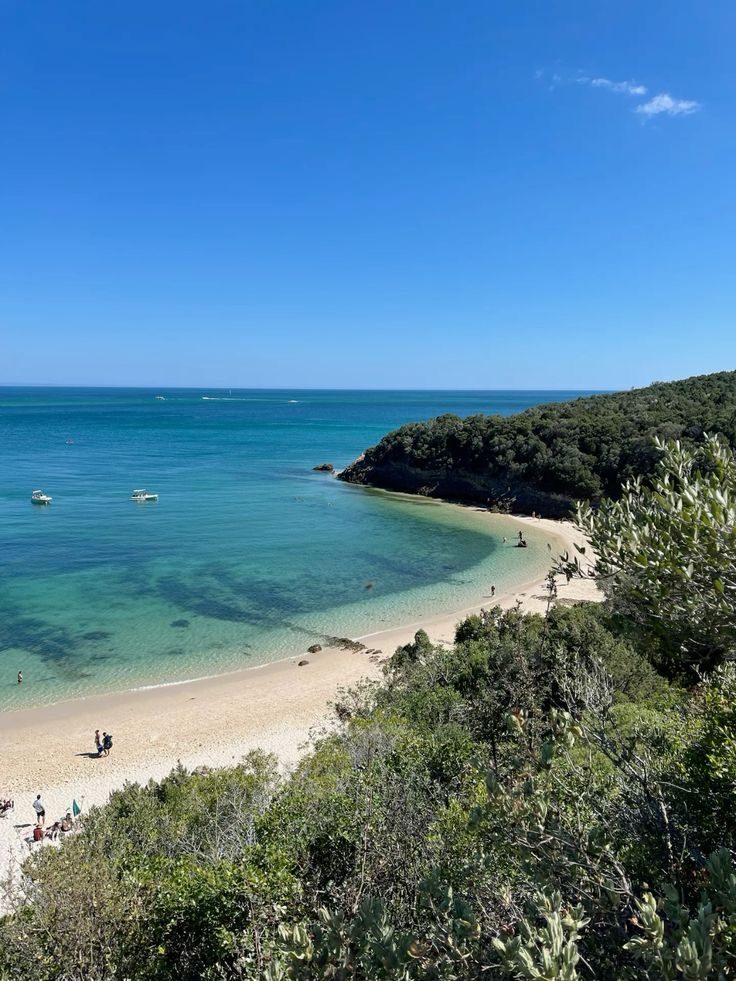
Arrábida Natural Park — 45 minutes from Lisbon, centuries from the ordinary.
The rhythm of four days
Four days is a very specific length. Not a weekend (too short, always slightly hurried), not a week (long enough to get strange ideas about staying forever). Four days is the time it takes to genuinely shift register — to move from the pace of your ordinary life into something different, and to have enough of that something different to integrate.
The programme at Retirarsi follows a rhythm:
- Morning Pilates — slow, intentional, grounding. Not a workout. A way of arriving in the body before anything else.
- Inner cartography sessions — guided inquiry into what you're carrying and what you want. The questions you haven't had time to ask yourself.
- Herbalism and the land — walks in the Arrábida landscape, learning to read what's growing and why. A way of connecting to something that has been here longer than any of us.
- Unscheduled time — this is as important as everything else. The nervous system needs space to integrate.
By the third day, something almost always shifts. It's hard to predict what. But I've been doing this long enough to trust that the shift comes — and that the small group, the landscape, and the rhythm together create the conditions for it.
Who comes
People come from Portugal, from the UK, from Germany, the Netherlands, France, Italy. They're not all the same — they come from different lives, different professions, different places in their inner geography. What they have in common is usually something like: I need to think. I need space. I need to stop long enough to hear myself.
They tend to leave with something they didn't arrive with. Not always a big answer — sometimes just a question they'd been avoiding, finally named. Sometimes a decision that had been waiting for them to be still enough to see it. Sometimes a quality of permission: to want what they want, to be who they are.
That's what a small group retreat near Lisbon gives you. Not an answer, but the conditions for your own.
Inner Compass Retreat
4 days in Arrábida Natural Park. Pilates, herbalism and inner cartography. Maximum 12 people. 45 minutes from Lisbon. From 830 €.
See the Retreat