I get asked this a lot: what actually happens on a retreat? Not in the brochure sense — people have read enough of those. But really: what happens to a person when they step away from their ordinary life for a few days and arrive somewhere with intention?
The honest answer is: different things for different people. But there are patterns. And I've been watching them long enough to know what tends to shift, and why Portugal — and Arrábida in particular — creates conditions that are difficult to replicate anywhere else.
First: what a retreat isn't
A retreat is not a holiday, though it can include beauty and rest. It is not a course, though you may learn things. It is not therapy, though it can be deeply healing. It is not an escape, though the distance helps.
A retreat is a deliberate interruption. A container. A space you enter with a question — even if you haven't named it yet — and leave with something you didn't have before. Sometimes that's clarity. Sometimes it's permission. Sometimes it's a feeling in the body that something has settled.
Why Portugal works
Portugal has something that's hard to define but easy to feel. The Portuguese call it saudade — a kind of tender longing, a presence to what is and what has been. The light here is different. The pace is different. Even the silence has a quality to it.
But beyond the intangible, there are practical reasons why people travel from across Europe and beyond to do retreat work in Portugal:
- The climate. More than 300 days of sunshine a year, including mild, dry autumns and springs when the rest of Europe is grey.
- The nature. Portugal preserves some of the most intact wild coastline in Western Europe — no overdevelopment, no crowds, actual wilderness.
- The food. Clean, seasonal, Mediterranean. Simple and genuinely nourishing.
- The access. Direct flights from most European cities make Portugal easier to reach than you might think. From Lisbon airport, Arrábida is 45 minutes.
- The price. Compared to retreats in Tuscany, the Algarve tourist circuit, or the UK, the value is remarkable.
Why Arrábida specifically
Arrábida is a natural park on the Setúbal Peninsula, about 45 kilometres south of Lisbon. It is one of Portugal's most protected landscapes — limestone mountains meeting a coastline of crystalline blue-green water, ancient forests of centuries-old carob and olive trees, wild herbs growing along every path.
I've been working in Arrábida for years, and what I know is this: the land has a particular quality of holding. When people arrive here, something relaxes that doesn't relax elsewhere. The scale of the landscape — the height of the cliffs, the depth of the forest, the openness of the sea — creates a kind of perspective that is very hard to manufacture. You feel small in the right way. Your problems take their actual size.
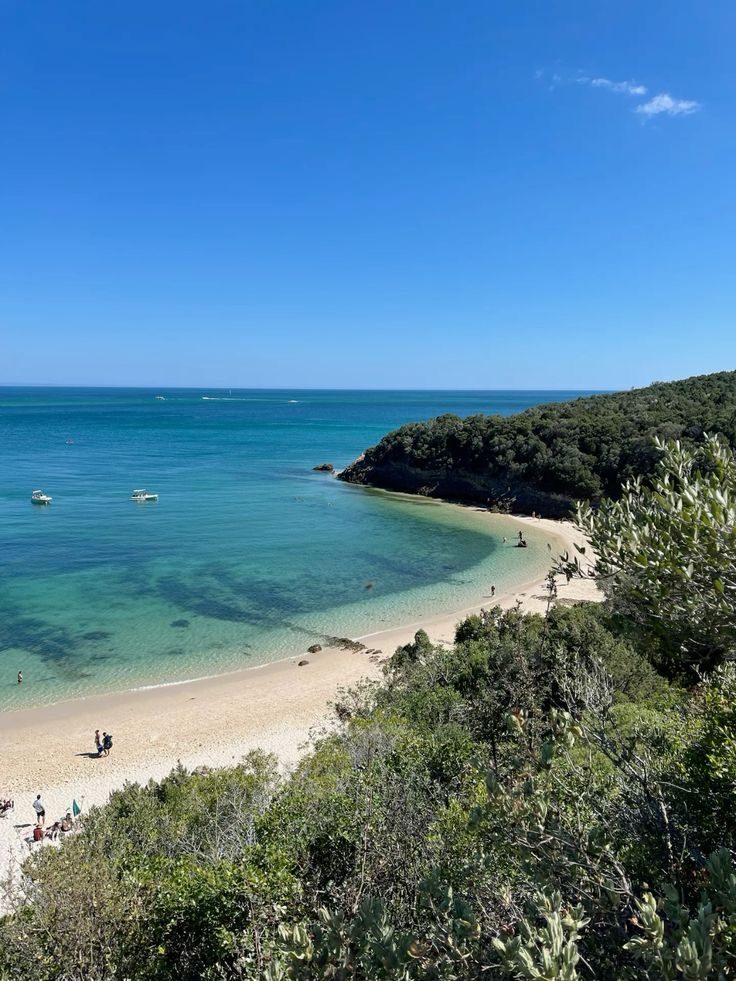
The Serra da Arrábida — protected natural park, 45 minutes from Lisbon.
What happens in a Retirarsi retreat
At Retirarsi, retreats follow a rhythm. Mornings begin with Pilates — not as exercise for its own sake, but as a way of arriving in the body. There's something about bringing attention to the physical self, to breath and alignment and the felt sense of being present, that prepares the ground for everything that comes after.
Afternoons include herbalism walks in the Arrábida landscape — learning to read the land, to notice what's growing and why, to develop a relationship with the place that goes beyond looking at it. And woven throughout the four days, inner cartography: guided sessions of reflection and inquiry that help you map what you truly want and what's in the way of it.
Evenings are unstructured. That matters. The nervous system needs unscheduled time to integrate what has moved during the day.
Who comes to a retreat in Portugal?
In my experience, the people who come to Retirarsi are not the people you'd expect from the wellness industry's version of a retreat. They're not particularly interested in Instagram or green juice. They're people at a turning point — a career change, the end of something, the beginning of something else, a decade turning over. People who have tried being busy and found it insufficient. People who want to think clearly, and who've found that thinking clearly requires, first, stopping.
They're curious people. Often quite high-achieving. Often carrying something they haven't quite named. They come to Arrábida because they sense, correctly, that the place will help them name it.
The question of timing
People sometimes wait until they're ready for a retreat. I understand the impulse, but I've noticed: readiness tends to arrive just after the point when you most needed to have gone.
The right time for a retreat is usually not when everything is calm and you have space. It's when you're beginning to feel the friction — the low-grade sense that something isn't quite working, that you're running on old assumptions, that life is happening at you rather than with you. That friction is information. The retreat is where you learn to read it.
Inner Compass
4 days in Arrábida Natural Park. Pilates, herbalism and inner cartography. Small group, maximum 12 people. 45 minutes from Lisbon. From 830 €.
Discover the Retreat